CPR & AED Free Online Course: Comprehensive Guide to Life-Saving Skills
Why Learn CPR and AED Use Today?
In Canada, tens of thousands of cardiac arrests occur every year. The reality is that most of these incidents happen outside of a hospital setting—at home, in the office, or in public spaces. When the heart stops, every second counts. Brain damage can begin in as little as four minutes, and the chances of survival drop by nearly 10% for every minute that passes without intervention.
The Canadian Health Care Provider Training (CHCPT) believes that financial barriers should never stand in the way of life-saving knowledge. That is why we offer this Free Online CPR & AED Course. Our goal is to empower every Canadian with the skills, confidence, and readiness to act when it matters most.
The Importance of the “Chain of Survival”
This course is built around the internationally recognized “Chain of Survival.” This concept represents the series of actions that, when performed in sequence, provide the best chance for someone to survive a cardiac arrest. By taking this course, you become the most critical link in that chain: The First Responder.
-
Early Recognition and Call for Help: Identifying the signs of cardiac arrest and calling 911 immediately.
-
Early CPR: Starting chest compressions to keep oxygenated blood flowing to the brain.
-
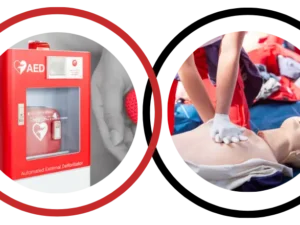
Early Defibrillation: Using an AED to “reset” the heart’s rhythm.
-
Advanced Care: Handing over to paramedics and hospital staff.
Detailed Course Curriculum Breakdown
Module 1: Introduction to Cardiopulmonary Resuscitation (CPR)
In this module, we demystify what CPR actually does. You will learn that CPR is not meant to “fix” the heart, but rather to act as a manual pump. We cover:
-
The Science of Compressions: Why depth (at least 2 inches) and rate (100–120 beats per minute) are vital.
-
Compression-Only CPR: Why “Hands-Only” CPR is a highly effective method for bystanders who may be uncomfortable with rescue breaths.
-
Personal Safety: How to assess a scene for hazards (traffic, fire, electricity) before you attempt to help.
Module 2: Mastering the AED (Automated External Defibrillator)
Many people are intimidated by AEDs, fearing they might “shock someone by mistake.” This course clears up those myths.
-
Voice Prompts: How the machine guides you through every step.
-
Pad Placement: Proper positioning for adults vs. children.
-
The “No-Shock” Scenario: Understanding that the AED will only deliver a shock if the patient’s heart rhythm requires it. You cannot accidentally shock someone whose heart is beating normally.
Module 3: Choking and Airway Obstructions
Cardiac arrest isn’t the only emergency. Airway obstructions are a leading cause of accidental death. We teach you:
-
The Universal Sign of Choking: How to recognize when someone is in distress.
-
The Heimlich Maneuver (Abdominal Thrusts): Step-by-step instructions for adults.
-
Special Cases: What to do if the victim is pregnant or significantly larger than you.
Module 4: Recognizing Heart Attacks and Strokes
Prevention is better than a cure. Many cardiac arrests are the result of a heart attack that wasn’t recognized in time.
-
Heart Attack Signs: Chest pain, radiating pain in the arm/jaw, nausea, and shortness of breath.
-
Stroke Recognition (FAST): Face drooping, Arm weakness, Speech difficulty, Time to call 911.
Canadian Compliance and Industry Standards
Our free course content is strictly aligned with the latest Emergency Cardiovascular Care (ECC) and International Liaison Committee on Resuscitation (ILCOR) guidelines. While this free version serves as an excellent foundational or “awareness level” course, it is designed to prepare you for the rigors of workplace safety expectations across all Canadian provinces.
Note: If you require a “Pro” level certificate for employment (such as for Nursing, Firefighting, or regulated Daycare), we recommend checking our BLS Certification Page for the fully accredited versions.
The Benefits of Online Learning with CHCPT
Traditional in-person classes can be time-consuming and expensive. Our digital platform offers:
-
Flexibility: Stop and start whenever you want. Your progress is saved automatically.
-
High-Quality Visuals: We use video demonstrations and high-resolution diagrams to ensure you understand the physical mechanics of CPR.
-
Knowledge Checks: Interactive quizzes help reinforce what you’ve learned, ensuring you don’t just “read” the material, but actually retain it.
Frequently Asked Questions (FAQ)
Q: Is this course really free? A: Yes. We believe basic safety knowledge should be accessible to everyone. There are no hidden fees to access the learning modules.
Q: Will I get a certificate? A: Upon successful completion of the knowledge checks, you will receive a digital “Certificate of Completion” that verifies you have finished the awareness training.
Q: How long does the course take? A: Most students complete the material in under 60 minutes. Because it is self-paced, you can move as fast or as slow as you need.
Q: Can I use this for my job? A: This depends on your employer. Many employers accept this as “Safety Awareness.” However, if your job specifically requires “WSIB-approved” or “Heart & Stroke” level certification, you may need one of our paid, proctored courses.
 Please note: This is not a Heart & Stroke Foundation course.
Updated on Jan 2026
For training with certification, you can reach out to our partner. They provide WSIB-approved courses
Training with certification
-
1
 Adult CPR, AED and Choking
This lesson teaches how to recognize cardiac arrest, perform high-quality adult CPR (compressions and breaths), use a mask and an AED safely, activate EMS quickly, and manage choking in adults with abdominal thrusts and CPR if the person becomes unresponsive.
-
2
Infant CPR and Choking
-
3
Child CPR, AED and Choking
-
4
CPR, AED & First Aid Practice Test


Please note: This is not a Heart & Stroke Foundation course.
Updated on Jan 2026
For training with certification, you can reach out to our partner. They provide WSIB-approved courses
Training with certification
 Google